Copyright:
ArcelorMittal
update
client newsletter

ArcelorMittal Europe – Flat Products
With measures for upstream steel significantly strengthened, the European Commission has been tasked with reviewing the impact of increasing steel product imports on the downstream sectors, and with considering the case for extending the TRQ's scope accordingly. The strength of the case will depend heavily on the evidence and input provided by manufacturers, the supply chain and other stakeholders.
Without active engagement, the case for extension is significantly weaker, and Europe risks further losing its manufacturing expertise, huge employment and strategic resilience.
The new TRQ system should reduce steel imports by roughly 40% by the end of 2027 (a reduction of approx. 8Mt) in comparison with 2024 levels. This should improve capacity utilisation rates for EU steel producers to more viable levels, as market demand will be oriented more fairly in their favour.
However, when trade measures are introduced for one part of the value chain, there is a high risk that importers simply find alternative routes and products on which to focus. They are now faced with two options: continue shipping primary steel into a market that has become considerably less accommodating, or shift that same steel one step further down the value chain, where it can currently enter the EU largely unconstrained.
The EU trade balance in fabricated metal products has been in negative territory since 2020. Diversionary trade distortion significantly threatens European downstream manufacturers further, most notably in critical sectors including automotive and transport, machinery, fabrication, energy and appliances, which are all steel-intensive users.
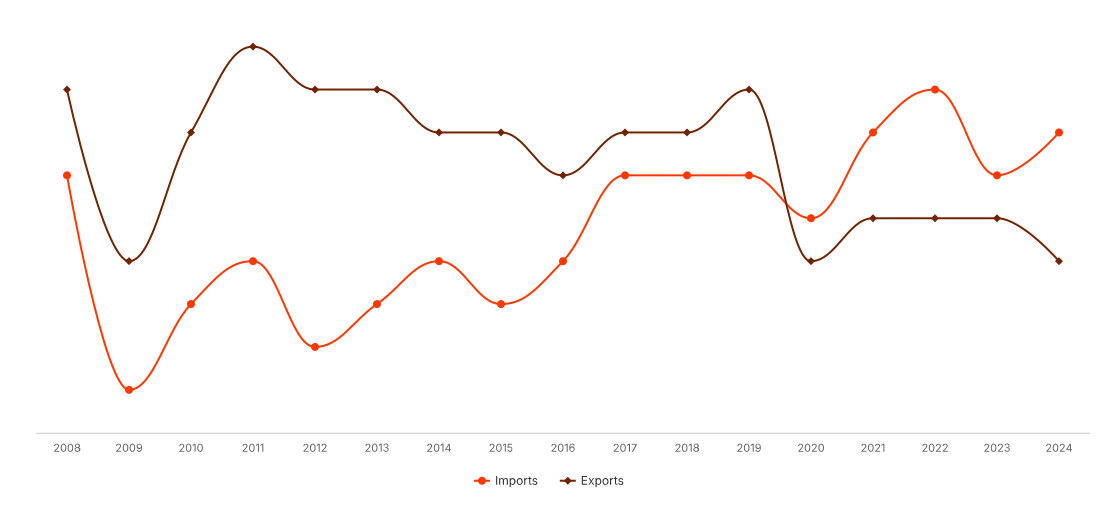
Source: German Federal Statistics
The debate is not simply about trade defence. Preserving Europe’s manufacturing and supply chains is critical for its employment, know-how, decarbonisation, strategic autonomy, resilience and economic security. But at present, our manufacturing and supply chains are being weakened by cheap imports from overseas markets: a red line is being crossed.
The European Commission’s Industrial Accelerator Act (IAA), currently only at proposal stage, is - alongside CBAM and TRQ - seeking to address this through restoring manufacturing to 20% of Europe’s GDP by 2035, and pursuing a Made in Europe focus.
But Europe’s manufacturers must themselves wake up, see the threat facing their businesses and join the call for action.
The same threats are being faced across the board in broader manufacturing and fabricating. There has been a steady decline in exports of fabricated metal products from Europe over the last 15 years or so, exacerbated by Covid, and a corresponding increase in imports, resulting in a net negative trade balance. A large part of manufacturing is structurally fragmented and made up of SMEs, making it hard to communicate the challenges with a single voice. But “divided we fall, united we stand,” and producers must come together to be heard. This is not just a fight for the steel companies: the winners should be the whole steel value chain in Europe.
Persistently choosing the cheapest import over the long-term viability of domestic production carries a real risk: Europe ends up "buying cheap" today and "making nothing" tomorrow — with lasting costs to skills, jobs, industrial capacity and economic resilience.
On the 7th September 2026, representatives of Europe's steel, metals distribution, processing and downstream manufacturing industries took a message to Brussels: “we must preserve the industrial value chains on which the European green transition, strategic autonomy, employment and resilience depend.”
EUROMETAL, which represents steel distributors, service centres, traders and other intermediaries across Europe, says the objectives of open markets, decarbonisation and fair trade “cannot be achieved if European producers and processors carry ETS, energy, labour and regulatory costs, while competing with imported steel-based products that do not face comparable conditions.”
The European Commission's review has effectively already begun, with formal consultation and data collection commencing in September. This process will run until June 2027, the legal deadline for the Commission's assessment. There is no obligation for the European Commission to take action, unless a robust case has been made.
Early engagement matters. Waiting for the problem to materialise is not a strategy. Sectors and producers that engage earlier will be better placed to ensure that their products and market dynamics are appropriately reflected from the outset in the discussion, its conclusions and any resulting regulatory changes.
European politicians and regulators have been listening. Communication and dialogue worked on the initial definition of CBAM and TRQ. If everyone along the value chain speaks up, from steelmaking through distribution, processing and downstream manufacturing, Europe will listen and act again. It works, but only if we act now:
At ArcelorMittal, we are playing our part, engaging directly with Brussels and stakeholders, supporting our customers, and putting them in touch with knowledgeable experts.

by Bart Staelens,
Head of operational pricing and marketing ArcelorMittal Europe – Flat Products